History of the Club
Early Days
The Pembroke club was described as ‘defunct’ in 1901 but had resumed playing by 1907 when a West of Llanelly League was formed. Pembroke was a founder member and beat Whitland 8-0 at home in the first league game, helped by the fact that a couple of Whitland players missed their train and didn’t arrive until half-time! This proved to be another false dawn for the club, because in September 1908 it was reported: At a meeting of the Pembroke Rugby Football Club, held at the East Gate Hotel on Monday evening, it was decided to disband the club owing to the scarcity of players, lack of interest, and difficulty in obtaining a suitable ground. All was not lost, however; occasional friendly matches were still being played and on Boxing Day 1909 a scratch Pembroke team played Pembroke Dock Quins at Lamphey Road, losing narrowly. This led to the Pembroke club being revived yet again and accepted back into the West of Llanelly League. As a local paper noted in 1910: The re-formed Rugby club at Pembroke has been taken up with great enthusiasm. With an enterprising secretary in Mr. R. Ward Davies, the club promises to be the most successful for many years, and greater interest will undoubtedly be taken in its movements in the West of Llanelly League. The club has an efficient captain in Dick Hubbard, and an able manager in Mr W Smith, which augurs well for its future. Ward Davies was the proprietor of a local newspaper and under his guidance the club finally took firm root, weathering the storm of World War One to be admitted as a full member of the WRU in early 1919 – only the fourth Pembrokeshire side to achieve that hallowed status. In that year Pembroke’s opponents included Carmarthen Quins, Llangwm, Neyland, Tenby United and Burry Port and the club’s home ground was at ‘Lamphey Road’, thought to be where the Bishop’s Park housing estate now stands.
1920s
The 1920s seems to have been a decade of consolidation for the Pembroke club, although it must have been rocked by the closure of Pembroke Dockyard in 1926 when many men were forced to leave the area to look for work. Fortunately, the club had a ready supply of talented young players graduating to the ranks from East End School where the school team was coached by one of the masters, Llanelly and Wales three quarter Ernie Finch.
By now wearing the familiar scarlet shirts, Pembroke RFC was renowned for playing with ‘speed and combination’.
125 Years of Pembroke RFC (Continued)
1930s
The 1930s began in fine style for Pembroke. As the Western Mail reported in February1930:
Defeating Llangwm by 37 points to nil on Saturday, Pembroke, for the first time, won the West of Llanelly League Cup. Unfortunately, Llangwm fielded only 13 players.
It was the beginning of a period of sustained success on the field. Records are scarce, but a history of Narberth Rugby Club written in 1982 notes that the Otters were Pembrokeshire KO cup-finalists three times in five years in the 1930s, being beaten each time by Pembroke – once by a disputed try in extra time when (according to the Narberth supporters, at least) the Pembroke winger put a foot in touch before scoring! In 1935 a Pembrokeshire Rugby Union was formed, with Pembroke being one of the eight clubs to become affiliated. Pembrokeshire teams continued to compete in West of Llanelly League competitions, however, with Pembroke’s opponents in the 1930s including local rivals such as Tenby and Pembroke Dock Quins, but also Furnace, Penclawdd, Pontyates, Kidwelly and Lampeter College. It seems that Pembroke’s success on the pitch came at a financial cost. The 1939 annual meeting was told that during the coming season the club would be concentrating on young players resident in the town instead of looking elsewhere for talent. It was reported that players’ travelling expenses for the past season had totalled more than the gate receipts at home matches. The outbreak of WWII meant that this policy was never implemented.
1940s AND 1950s With the resumption of rugby following the War, one of Pembroke RFC’s main concerns was to secure a pitch. Reported a local newspaper in 1947: Pembroke Rugby Club are experiencing great difficulty in obtaining a ground. Although they have negotiated to purchase a field, the price – which is in the region of £l,000 – is considered prohibitive.
With Pembroke cricket club about to lose its Shoulder of Mutton pitch in the Green to council
Members of the Pembroke RFC Women Supporters’ Club outside the new pavilion opened in September 1952 on the club’s playing field. On the extreme left is Lieut-Col Percy Howells representing the WRU, who officially opened the pavilion. Others in the photograph include Mrs Margaret Wrench, secretary of the Supporters’ Club, Mr Ronald Jones, chairman of the club and Mr Bert Lewis, life member. housing, the local authority stepped in and earmarked land on the Upper Lamphey Road for use as sports fields – the present Crickmarren and Tre-leet grounds. Thus, at the 1947 annual meeting, chairman Ron Jones was able to announce that a new playing field had been acquired and also that the club was going to compete in the newly formed Pembrokeshire and District League as well as playing matches against west Wales clubs. The 1955 Pembrokeshire League Champions: Back row: L Culley (treasurer), E Smith (chairman), L Skeels, D Charles, E Lewis, L Thompson, D Ellis, G Hughes, B Colley, E Wrench (secretary), E M Hay (life member). Middle row: W Cray, I Lewis, J Shanklin (captain), R Walker, F Weatherall (vice-captain). Front row: G. Lewis (trainer), T Howells, E Evans, T Dudman, I Morgans (touch judge).
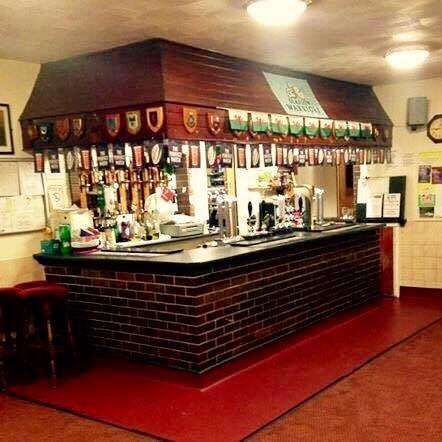
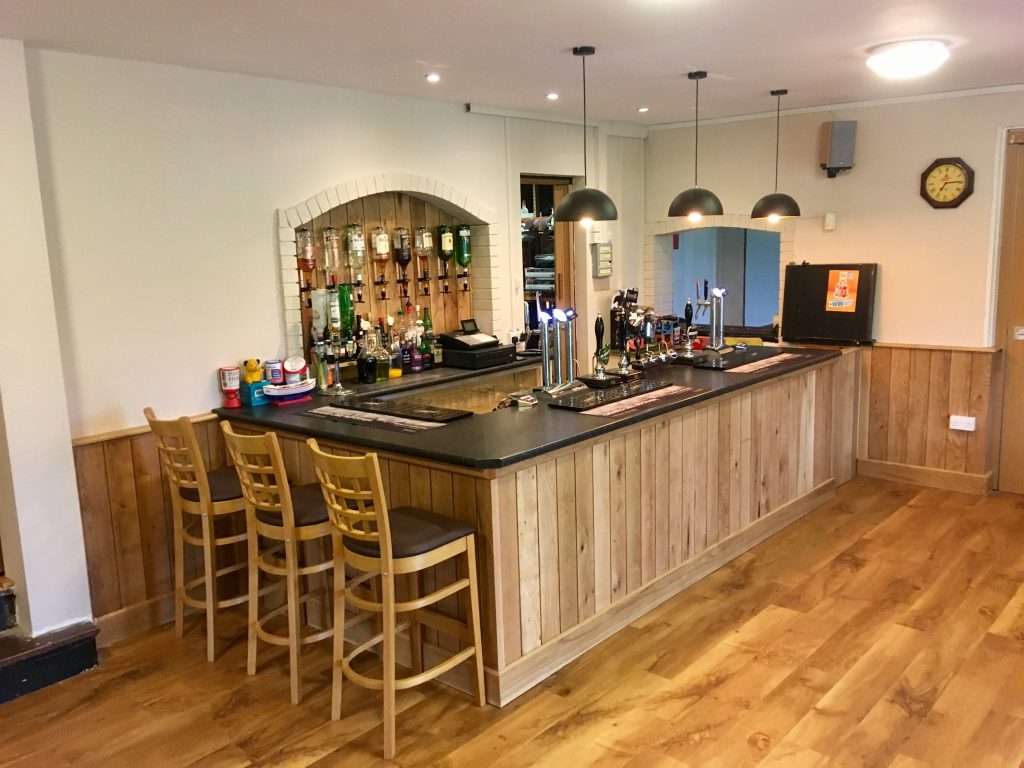
For the first time ever he also welcomed a number of ladies to the meeting who showed their interest in the club by forming a Ladies Supporters Committee. This committee was instrumental in raising funds for a pavilion to be built alongside the new pitch – much- needed, because previously the players had to change behind the East Gate pub and walk to the match. Incorporating a small kitchen where the ladies brewed tea after the game, the pavilion was opened in 1952. There was more success on the pitch when a Pembroke team captained by Chris Leonard won the KO Cup in 1948, while 1954/55 was probably Pembroke’s finest season, with John Shanklin leading the team to the Pembrokeshire League title and to runners-up spot in the KO Cup. The club also hosted a touring team from Stow on the Wold – the first English club ever to play in Pembroke – winning with a late try by winger Ivor Lewis. 1960s TO 1980s The sixties began with Pembroke again winning the Pembrokeshire KO Cup under the captaincy of Derek Hayward – sadly the last occasion on which the trophy was to come to Crickmarren. The club continued to develop both on and off the field, launching a Youth Team and a Second XV. A splendid new clubhouse was built, opened by WRU president Ken Prosser, with an active social committee overseeing events and entertainment. Though rarely challenging for honours, the First XV enjoyed excellent support at this time, the biggest crowds being reserved for the Boxing Day derby with old rivals Pembroke Dock Quins and the Fair Day match against Tenby. Meanwhile the club took great pride in the achievements of Monkton-born prop forward Mike Knill who began his rugby career at Crickmarren before moving to Cardiff where he played over 200 games for Cardiff RFC and gained a Welsh cap against France in 1976. Pembroke has always been blessed with enthusiastic committee men and women, and thanks to their work the club was able to acquire a training pitch just down the road and build new changing rooms, install floodlights, and erect a grandstand alongside the main pitch – facilities which have allowed the club to host a number of cup-finals and county games.
RECENT TIMES
Pembroke RFC celebrated its centenary in the 1996–1997 season with a players’
reunion and a centenary dinner held in a marquee on the club ground. By this time the Pembrokeshire League was no more, having been abolished by the WRU in favour of a new national pyramid system. While many regretted this decision, as it put an end to a number of long-standing local rivalries, Pembroke has gone on to enjoy considerable success under the new system, rising through the ranks in the WRU West section. Pembroke was promoted from Division 6 West at the end of the 2003/04 season and moved to Division 5 West, being promoted the following season to Division 4 West. More recently the club won League 3 West A in 2018 and finished runners-up in League 2 West in 2019, resulting in promotion to League 1 West.
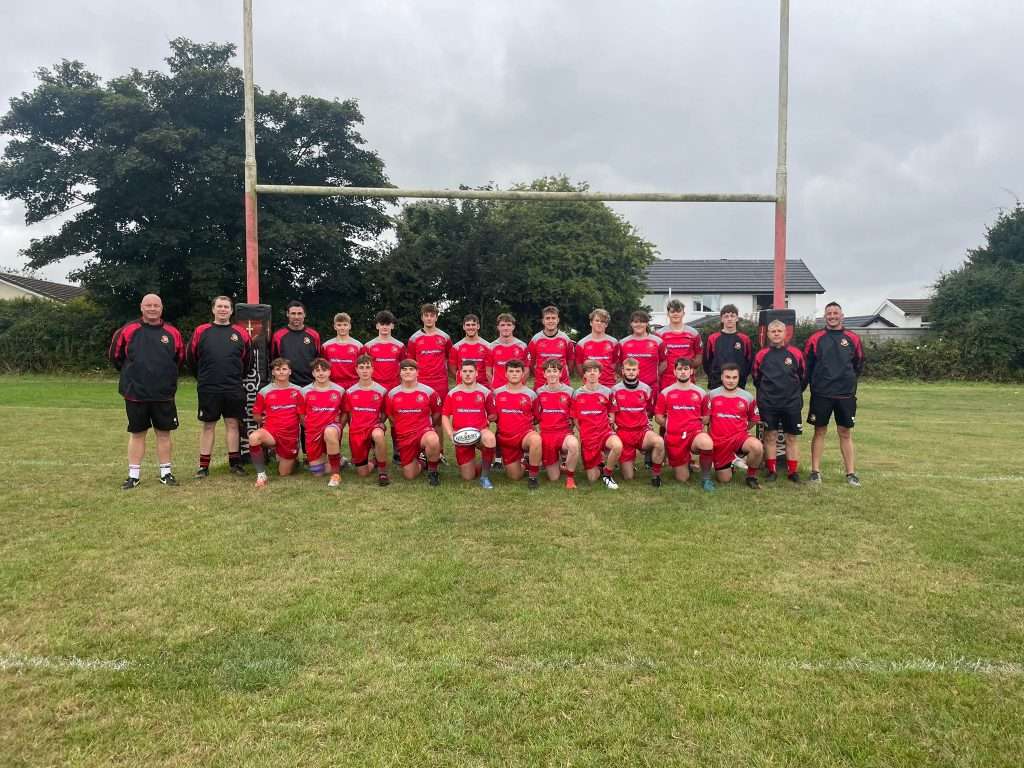
Very proud Senior squad with coaches and club officials at the Millennium Stadium prior to WRU Bowl Final v Prthcawl, 2018. A memorable achievement came in 2018 when Pembroke RFC reached the final of the WRU National Bowl held at the Principality Stadium in Cardiff. Roared on by their supporters, Pembroke came within a few minutes of lifting the Bowl, only to concede a late penalty and lose 33-31 to Porthcawl. It was a remarkable double for the Pembroke club, whose youth team had the honour of playing at the Principality Stadium just one week previously in the National Youth Plate Final, going down gallantly to Tondu 29-19. A number of Pembroke players have gone on to represent Wales at various levels in the past couple of decades, from Youth and Junior Union to full international. Former Youth Team flanker Rob Appleyard became a Swansea stalwart and was capped nine times for Wales, while Jonathan Thomas began his rugby career in the Pembroke junior section and went on to captain the Ospreys and to win two Grand Slams and 67 caps during his career with Wales. Other Youth Team products include Dominic Day who played for the Scarlets and Bath and won Welsh caps at Under 19, Under 21 and full international level, while Luke Hamilton played for Cardiff Blues and gained three caps for Scotland, the land of his father.
For the first time ever a Ladies Team was formed in 2018 – the Pembroke Panthers – while the club also has a well-established junior section with teams of different ages all with dedicated coaches. All of this would surely have been unimaginable to the dockyard workers and farm lads who came together – probably in the East Gate – to form that first Pembroke team 125 years ago.
